Kristin Kimball's memoir, The Dirty Life, is a page turner. It is also so deep in insights about economic philosophy, culture and community, life transformations, and of course, farming, that it bears rereading over and over again. The most beautiful part of their story is the character of the
relationships they forge in the community. Kristin refers to a "larger loving-kindness" at work in the center of their community, their farm, and their own lives.
Kristin and her husband Mark are deeply committed to making their farm truly sustainable. Mark asks passionately "who can catch the most sunlight and keep it?" "All life is fueled
by the sun. How can we sustain seven billion people using available
sunlight? Can we do it here on this farm, for 100 people, or 200
people, or 8000 people? ... We capture the sun with plants and we let go of that sun
with breath and fire. All we need to do is make sure we are capturing
more sun than we breathe or burn."
"We live on the sun’s savings account: fossil fuel. That’s sunlight in
plants that just didn’t get to be breathed or burned when those crazy
microbes and plants of the Cambrian and post Cambian eras died and went
into the earth. We discover this coal and oil and it makes it so easy to
be us. A barrel of oil can do the work of ten years hard physical
labor. Only one drawback (just kidding, there’s lots of drawbacks):
suddenly we’re letting all of that CO2 into the air...So back to the challenge: who can catch the most sunlight and keep it? A farm has the ability not only to be carbon neutral – that is, catching as much carbon as we release – but to be a carbon sink,
so our net energy capture exceeds our net energy release. Net energy
profit will live in the soil organic matter, which makes for healthier
soil, which makes it easier for us to grow more plants and catch more
energy." http://www.kristinkimball.com/blog/?p=66
How well has Essex Farm been doing in capturing the most sunlight and keeping it? How can we tell? Essex Farm, with its use of draft horses, seems to be mainly inspired by the Amish model. Is the Amish farming model good enough since it predates machinery powered by fossil fuel? How does it compare with the Permaculture design model?
The case of the Misato Rose:
In the book, Kristin describes their first planting of Misato Rose radish. They had a beautiful bountiful harvest. By 2012 week 45, in the Farm Blog, Kristin mentions that the Misato Rose was unusable, riddled with worm holes. Hmmm...this is a bad progression, a growing imbalance between predatory insects and their plant prey over time with the pests winning, an indication of a nonsustainable design. http://www.kristinkimball.com/blog/?m=201301&paged=2
The Soil and the Fields:
Kritstin notes that plowing is an act of violence, ripping into the Earth, disrupting whole communities of soil life. Planting annual crops in plowed rows means (1) lots of bare ground and (2) a maximum of only one or two crops per season. Permaculture on the other hand copies Nature in keeping the ground covered year round with sun catching, water retentive, nutrient building, plants. These plants stack in space and time to yield multiple crops.
The Water:
The Essex Farm fields are sometimes too wet and drainage was installed. Permaculturists like Sepp Holzer, in contrast, would use the excess water as a resource, building swales for water retention and seasonal ponds to raise fish. The fish in turn would feed on insects that would otherwise be pests.
The Farm Animals:
Kristin is refreshingly honest about their problems with farm animals. The prevalence of injuries among the cattle due to goring led to them to disbud (remove the horns) from young animals. Their chickens occasionally descended into cannibalism. These are signs of overcrowding. Sepp Holzer gives his animals sufficient space in rugged outdoor shelters and is able to leave their horns and beaks intact.
Overgrazing:
Kristin and Mark rotated their grazing but violated Joel Salatin's "Law of the Second Bite" by leaving thier animals too long on the same grass, a practice that damages pasture. http://sailorssmallfarm.wordpress.com/2012/06/25/joel-salatin-workshop-part-3-grass/
The Farm Membership:
Mark's vision of a whole diet, free choice CSA charged on a means-based
sliding scale going down as low as zero depends on 100% mutual honesty,
trust, and cooperation. (Can't see this working in NYC, lol!)Ten years
later, has it proved to a sound idea? Kristin writes that almost everyone
they knew thought the project would fail, although they continued to be
helpful. The outstanding character demonstrated by all the parties involved, from the
landowner Lars Kulleseid, the Essex community, the farm Members, the farm workers, even the farm animals in some instances, and of course Mark and Kristin, has been a
fulfillment of Mark's "wingnut" ideal of human goodness and generosity.
In many of Kristin's Blogs, she is extending thanks to someone or other
for their helpfulness. Essex Farm grew from feeding 7 members in 2004 to
over 200 members in 2014.
Yet a nagging question remains...has the cost been consistent with sustainability?
2004 Full Price - $2700 per year for the first adult in a household.
2014 Full Price - $3700 per year for the first adult in a household.
Kristen notes that they struggle to pay their workers and to cover their costs. If a farm is able to store "net energy profit" in the soil and improve fertility from year to year, shouldn't stable or lower prices be the trend?
The Energy Challenge:
From Kristen's Sept 19, 2012 Blog - "Our current conclusion is pretty simple. If we pay our employees a
living wage with health insurance, and use draft horses for our work,
then we need some sort of external subsidy. This is an issue, by the
way, even on farms that are not powered by horses – so many small local
producers are economically viable only because of free or cheap ‘intern’
labor; health insurance, which we began offering our employees this
year, is almost unheard of. And certainly we are not alone in trying to
find ways to pay for an environmental benefit that is usually
externalized, invisibly, through the use of fossil fuel. To quote Bill
McKibben’s striking statistic, one barrel of oil contains the same
amount of energy as ten years of manual labor. The oil costs about a
hundred bucks. Ten years of a living wage is somewhere between a quarter
and half a million." http://www.kristinkimball.com/blog/?p=219
Can this energy challenge be surmounted? Permaculture's answer lies in letting Nature's wealth building processes be the subsidy...not robbing from the past in the form of fossil fuel and not borrowing from the future in the form of public and private debt.
Kristen writes "Farmers toil. Nature laughs. Farmers weep. That's your history of agriculture in a nutshell."
Does it need to stay this way? In future Blogs, we'll profile farms and gardens that are designed to cooperate with Nature.
Saturday, May 31, 2014


Wednesday, April 30, 2014
Can We Be Proactive in Improving Our Health?
Our nation is embarking on a controversial health care experiment. Can the Affordable Care Act aka. Obamacare succeed in reducing overall costs while covering more people? Or will it accelerate our country towards bankruptcy without improving our overall health? It remains to be seen. Meanwhile the biggest elephant in the room is largely ignored - namely that we can take proactive steps as individuals to improve our own health and keep our healthcare costs down.
Dr. Colin Cambell's research on diet and health started in 1980, culminating in the publishing of The China Study in 2005. http://en.wikipedia.org/wiki/The_China_Study
The book:
http://www.amazon.com/dp/1932100660/?tag=googhydr-20&hvadid=31697403636&hvpos=1t1&hvexid=&hvnetw=g&hvrand=931428392591389644&hvpone=&hvptwo=&hvqmt=b&hvdev=c&ref=pd_sl_3la7mjf8yj_b
The cheatsheet:
http://www.wellandgoodnyc.com/2011/09/23/china-study-cheat-sheet-10-things-you-need-to-know/
1. American health statistics are scary. You may feel fit as a fiddle, but the country is unwell. Almost a third of adults over 20 are obese; one out of thirteen people have diabetes; and heart disease kills one out of every three Americans. We also pay more for our health care than any other country, and we don’t have better health to show for it.
2. Animal protein promotes the growth of cancer. The book author T. Colin Campbell, PhD., grew up on a dairy farm, so he regularly enjoyed a wholesome glass of milk. Not anymore. In multiple, peer-reviewed animal studies, researchers discovered that they could actually turn the growth of cancer cells on and off by raising and lowering doses of casein, the main protein found in cow’s milk.
3. Pesticides are gross, but none switch on cancer like poor nutrition. The food you eat affects the way your cells interact with carcinogens, making them more or less dangerous. “The results of these, and many other studies, showed nutrition to be far more important in controlling cancer promotion than the dose of the initiating carcinogen.”
4. The study findings are bulletproof. After years of controversial lab results on animals, the researchers had to see how they played out in humans. The study they created included 367 variables, 65 counties in China, and 6,500 adults (who completed questionnaires, blood tests, etc.). “When we were done, we had more than 8,000 statistically significant associations between lifestyle, diet, and disease variables.” In other words, there’s no arguing with the findings, Meat Council of America. Sorry.
5. The results are simple: Eat plants for health. “People who ate the most animal-based foods got the most chronic disease. People who ate the most plant-based foods were the healthiest.”
6. Heart disease can be reversed through nutrition. Caldwell B. Esselstyn, Jr., M.D., a physician and researcher at the best cardiac center in the country, The Cleveland Clinic, treated 18 patients with established coronary disease with a whole foods, plant-based diet. Not only did the intervention stop the progression of the disease, but 70 percent of the patients saw an opening of their clogged arteries. Dr. Dean Ornish, a graduate of Harvard Medical School, completed a similar study with consistent results.
7. Carbs are not the enemy. Highly-processed, refined carbohydrates are bad for you. But plant foods are full of healthy carbs. Research shows that diets like the Atkins or South Beach can actually cause dangerous side effects. While they may result in short-term weight loss, you’ll be sacrificing long-term health.
8. Plants are powerful. It’s not just cancer and heart disease that respond to a whole foods, plant-based diet. It may also help protect you from diabetes, obesity, autoimmune diseases, bone, kidney, eye, and brain diseases.
9. You don’t have to tailor your diet for specific health benefits. Eating healthy can seem segmented—broccoli will prevent breast cancer, carrots are good for eyes, did you get enough vitamin C today? “Nutrition that is truly beneficial for one chronic disease will support health across the board.”
10. Plants do it better. “There are virtually no nutrients in animal-based foods that are not better provided by plants.” Protein (YES, PROTEIN!), fiber, vitamins, minerals—you name it, they’ve got it, and the health benefits. —by Lisa Elaine Held

The cookbook:
http://www.amazon.com/The-China-Study-Cookbook-Plant-Based/dp/1937856755#reader_1937856755
Some sample meals and recipes:
http://www.epicurious.com/articlesguides/healthy/news/diet_vegetarianvegan
I tried out the Campbell/Esselstyn/China Study way of eating for 5 weeks as a Spring detox. Reading Dr. Campbell's book, Whole, finally convinced me. It wasn't easy to eat only whole vegan foods without added salt, sugar, or oils, lol. Which did I miss the most? Ice cream? Chocolate? Meat? Cheese? Fried foods? I missed all of the above but...I did feel noticeably better. I've made some permanent changes in my ongoing food habits and plan to revisit the whole food vegan approach periodically.
Is the China Study the last word on how to be healthy? Hardly, here's one of the many interesting critiques http://www.proteinpower.com/drmike/cancer/the-china-study-vs-the-china-study/ Still, the responsibility of seeking healthier lifestyles rests on us as individuals and our choices will undoubtedly affect the outcome of the ACA.
Monday, March 31, 2014
Water, Water, Everywhere, How About a Drop to Drink?
Have you gotten a set of Paul Wheaton's Permaculture Playing cards yet? Many of the topics featured on these beautiful and sneakily educational cards have a bearing on natural water management strategies. Order on Amazon here

Ace of Clubs: Hugelkultur http://www.richsoil.com/hugelkultur/
King of Spades: Sepp Holzer http://www.holzeragroecology.com/
Queen of Clubs: Greening Deserts
Jack of Spades: Mike Oehler
Jack of Hearts: Willie Smits
Jack of Clubs: Allan Savory
Jack of Diamonds: Art Ludwig
Ten of Spades: Paddock Shift Systems
Ten of Hearts: Greywater
Nine of Clubs: Jean Pain
Eight of Spades: Natural Swimming Pool
Eight of Clubs: Tefa
Eight of Diamonds: The Man Who Planted Trees
Seven of Hearts: Pigs
Seven of Clubs: Pee
Seven of Diamonds: Replacing Irrigation with Permaculture;
Six of Spades: Ben Law
Five of Clubs: Beyond Compost
Five of Diamonds: Wind and Berms;
Three of Spades: Food Forest
Three of Clubs: Dry Outhouse
The difficulty of accessing fresh potable water in many parts of the world including our West Coast has become an increasingly serious problem. Can this problem be solved with Permaculture inspired solutions?
Friday, February 28, 2014
No It's NOT About the Delta Smelt!
The current water crisis in Southern California has been many years in the making yet many of the parties involved still miss the point that water is a precious resource that needs to be managed wisely. It's shocking to see misinformation all over the news media. Here is a compilation of resources to clarify the situation:
There really isn't enough water to go around. Northern California had only 6.12" of rainfall last year, LA had only 3.6". Contrast this with the approximately 50"s of annual rainfall we get in NYC. http://www.weather.com/news/weather-forecast/california-record-driest-year-20131115
The story about the Delta smelt is a red herring. The core question is "are we growing the right food in the right places and with the best technology possible to reduce water use?"
http://www.resilience.org/stories/2014-02-17/fantasizing-about-california-or-already-here-5-shocking-drought-facts-to-make-you-rethink-the-golden-state
http://www.sltrib.com/sltrib/politics/57552641-90/rationing-percent-voluntary-district.html.csp?page=1
"History tells us that a defining moment in our use of the earth's water came with....the harnessing of fossil fuels during the Industrial Revolution...water mining took hold in arid and semiarid lands...an orgy of consumption ensued...amid alarming signs...that the supply of underground water is finite and not being replaced at anything like a sustainable rate. Yet most of us...still take water for granted and live in a state of denial...California is a case in point..."
Elixir: A History of Water and Humankind by http://www.amazon.com/Elixir-A-History-Water-Humankind/dp/B008PHJPV0
| Soil plowed for monoculture of annual crops - a recipe for disaster |
| Photo from Panoramio.com (23122266) |
This is a recent interview with the Village Homes architect, Michael Corbett
http://www.youtube.com/watch?v=eI3XXbsTizQ
From the Village Homes website:
http://www.villagehomesdavis.org/public/about
Natural Drainage — The common areas also contain Village Homes' innovative natural drainage system, a network of creek beds, swales, and pond areas that allow rainwater to be absorbed into the ground rather than carried away through storm drains. Besides helping to store moisture in the soil, this system provides a visually interesting backdrop for landscape design.
Edible Landscaping — Fruit and nut trees and vineyards form a large element of the landscaping in Village Homes and contribute significantly to the provender of residents. More than thirty varieties of fruit trees were originally planted, and as a result some fruit is ripe and ready to eat nearly every month of the year.
Orientation — All streets trend east-west and all lots are oriented north-south. This orientation (which has become standard practice in Davis and elsewhere) helps the houses with passive solar designs make full use of the sun's energy.
Government subsidies for farmers and consumers just send fake money chasing scarce goods. It will only raise prices while exacerbating the Federal Debt. Can we turn more of our neighborhoods into ecologically well designed food forests like Village Homes? Can we design with Nature to create and preserve lasting wealth? A look at some of the projects underway worldwide will be the subject of a future Blog.
*Related: The Aug 2013 post addressed the pattern of drought/forest fires/flooding/erosion in California:
http://greennewyorkersmeetup.blogspot.com/2013/08/forest-fires-insights-from-sepp-holzer.html
Friday, January 31, 2014
Is this Winter's Icy Weather a Reprieve from Global Warming?
The term Polar Vortex has been on every newscaster's lips recently. Is the cold a reprieve from global warming?
Here's Rush Limbaugh's take:
http://www.rushlimbaugh.com/daily/2014/01/06/left_creates_polar_vortex_to_make_you_think_winter_is_caused_by_global_warming
I want everything to be legit, you know, up and up. Global warming is a great example. It's a full-fledged, now documented hoax. Yet if you listen to the news media, it's still in full swing, and it explains this cold snap. I have here in my formerly nicotine-stained fingers a website. It's Business Insider, of all things, that explains the polar vortex. Now, I want to read this to you. "As tundra-like temperatures and wind chills as cold as 70 below zero fan out across the country, everyone is blaming the 'polar vortex.' Polar vortexes, though, are nothing new. They occur seasonally at the North Pole, and their formation resembles that of hurricanes in more tropical regions: fast-moving winds build up around a calm center.
"Unlike a hurricane, these are frigid polar winds, circling the Arctic at more than 100 miles per hour. The spinning winds typically trap this cold air in the Arctic. But the problem comes when the polar vortex weakens or splits apart, essentially flinging these cold wind patterns out of the Arctic and into our backyards. NOAA scientists have suggested," which means they don't have the foggiest idea.
National Oceanic and Atmospheric Administration "scientists have suggested that warming temperatures in the Arctic may be responsible for the weakening of the polar vortex." So, you see, it's magic! Supposedly, man-made global warming is causing record cold, because warming temperatures may be responsible for the weakening of the polar vortex -- and when the polar vortex weakens, it's more likely to break apart and become a factor in our winter weather.
Rush Limbaugh is so sure Arctic ice hasn't diminished that it sounds as if he has been there to see for himself, lol. Unfortunately for those of us who wish we didn't need to face a global Climate Change crisis, there is thorough and reliable documentation of Arctic ice melt. In addition, there will be many opportunities to view displays of weakening vortices when the figure skaters perform in the upcoming Winter Olympics. http://www.npr.org/blogs/thetwo-way/2014/01/07/260455201/what-is-the-polar-vortex-and-why-is-it-doing-this-to-us
Anyhoo, my hopes for a Winter garden full of chickweed, Asian cabbage, and fava beans have been iced. Something of concern to all of us regardless of political views is that extreme weather is bad for our ability to grow food. I've been paying closer attention to Sepp Holzer's Alpine farming methods:
http://www.permaculture.co.uk/videos/visit-sepp-holzers-permaculture-farm
Visit Sepp Holzer's amazing, biodiverse farm 1500 metres (almost 5000 feet) on an Austrian mountain. Most neighbouring farmers mainly 'farm' monocultural spruce plantations, Sepp is able to produce an incredible range of crops through the creation of microclimates and his unique water management systems. Sepp builds water retaining ponds and lake systems high up on the mountain which have become thriving aquacultures producing fish for the table as well as wildlife habitats teeming with biodiversity. The water creates microclimates around the banks where Sepp is able to grow an abundant edible landscape of fruit and nut orchards plus heritage vegetable and grain crops planted along the banks. In a cold Alpine climate you can find oranges, lemons and kiwis growing, as well as numerous other fruits and vegetables.
In my little urban garden, I'll be able to use stones, mirrors in lieu of ponds, and small scale Hugelkulture. What changes are needed in our commercial farming system? Where there's food there's hope ;-)
Here's Rush Limbaugh's take:
http://www.rushlimbaugh.com/daily/2014/01/06/left_creates_polar_vortex_to_make_you_think_winter_is_caused_by_global_warming
I want everything to be legit, you know, up and up. Global warming is a great example. It's a full-fledged, now documented hoax. Yet if you listen to the news media, it's still in full swing, and it explains this cold snap. I have here in my formerly nicotine-stained fingers a website. It's Business Insider, of all things, that explains the polar vortex. Now, I want to read this to you. "As tundra-like temperatures and wind chills as cold as 70 below zero fan out across the country, everyone is blaming the 'polar vortex.' Polar vortexes, though, are nothing new. They occur seasonally at the North Pole, and their formation resembles that of hurricanes in more tropical regions: fast-moving winds build up around a calm center.
"Unlike a hurricane, these are frigid polar winds, circling the Arctic at more than 100 miles per hour. The spinning winds typically trap this cold air in the Arctic. But the problem comes when the polar vortex weakens or splits apart, essentially flinging these cold wind patterns out of the Arctic and into our backyards. NOAA scientists have suggested," which means they don't have the foggiest idea.
National Oceanic and Atmospheric Administration "scientists have suggested that warming temperatures in the Arctic may be responsible for the weakening of the polar vortex." So, you see, it's magic! Supposedly, man-made global warming is causing record cold, because warming temperatures may be responsible for the weakening of the polar vortex -- and when the polar vortex weakens, it's more likely to break apart and become a factor in our winter weather.
 |
| www.treehugger.com |
 |
| http://www.liveweatherblogs.com/index.php?option=com_community&view=groups&task=viewdiscussion&groupid=44&topicid=69425&Itemid=179Add caption |
Anyhoo, my hopes for a Winter garden full of chickweed, Asian cabbage, and fava beans have been iced. Something of concern to all of us regardless of political views is that extreme weather is bad for our ability to grow food. I've been paying closer attention to Sepp Holzer's Alpine farming methods:
http://www.permaculture.co.uk/videos/visit-sepp-holzers-permaculture-farm
Visit Sepp Holzer's amazing, biodiverse farm 1500 metres (almost 5000 feet) on an Austrian mountain. Most neighbouring farmers mainly 'farm' monocultural spruce plantations, Sepp is able to produce an incredible range of crops through the creation of microclimates and his unique water management systems. Sepp builds water retaining ponds and lake systems high up on the mountain which have become thriving aquacultures producing fish for the table as well as wildlife habitats teeming with biodiversity. The water creates microclimates around the banks where Sepp is able to grow an abundant edible landscape of fruit and nut orchards plus heritage vegetable and grain crops planted along the banks. In a cold Alpine climate you can find oranges, lemons and kiwis growing, as well as numerous other fruits and vegetables.
In my little urban garden, I'll be able to use stones, mirrors in lieu of ponds, and small scale Hugelkulture. What changes are needed in our commercial farming system? Where there's food there's hope ;-)
Tuesday, December 31, 2013
Aiming for a Happy, Healthy, and Prosperous New Year
At this time of year, many of us are sending and receiving wishes for a Happy, Healthy, and Prosperous New Year. What can help us achieve and
maintain these desirable states?
Happiness
The late Dr David Servan-Schreiber lists positive social connections and an active interest in matters higher than ourselves as essential human needs on a par with the physical needs for food, water, and shelter. http://www.amazon.com/Instinct-Heal-Depression-Anxiety-Without/dp/1594861587/ref=sr_1_1?s=books&ie=UTF8&qid=1388471285&sr=1-1#reader_1594861587
Let's use our Green New Yorker Meetup group to increase our connections and our involvement and thereby our happiness ;-)
Health
Dr Servan-Schreiber's observation;
"Every single place where American diet has spread has seen massive increases in obesity rates and cancer rates. Japan is increasing consumption of red meat and dairy products and seeing an enormous increase in obesity and great increases in prostate cancer and breast cancer, which were extremely rare before." http://www.psychologytoday.com/blog/brainstorm/200904/david-servan-schreiber-cheating-death
Dr Schreiber, who kept his own brain cancer at bay for 19 years, gives us 19 simple anticancer and prohealth rules:
http://www.huffingtonpost.com/david-servanschreiber-md-phd/20-new-anticancer-rules_b_450166.html
His book:
http://www.amazon.com/Anticancer-A-New-Way-Life/dp/0670021644
(Dr Servan-Schreiber has been roundly crticized by the medical establishment for "going over to the woo". Despite this I remain a very big fan of this version of "woo"!)
Prosperity
Does it seem as though our current economy is geared towards wealth destruction? Is it easy to think of ways our society increases the GDP in the short term while actually decreasing human living standards in the longer term?
In contrast, designing a way of living based on the way natural systems capture and use resources leads to prosperity that is genuine and sustainable. http://shadesofgreeninc.org/about/what-is-permaculture/
Wishing everyone an exciting and successful journey towards Happiness, Health, and Prosperity in 2014!

Happiness
The late Dr David Servan-Schreiber lists positive social connections and an active interest in matters higher than ourselves as essential human needs on a par with the physical needs for food, water, and shelter. http://www.amazon.com/Instinct-Heal-Depression-Anxiety-Without/dp/1594861587/ref=sr_1_1?s=books&ie=UTF8&qid=1388471285&sr=1-1#reader_1594861587
Let's use our Green New Yorker Meetup group to increase our connections and our involvement and thereby our happiness ;-)
Health
Dr Servan-Schreiber's observation;
"Every single place where American diet has spread has seen massive increases in obesity rates and cancer rates. Japan is increasing consumption of red meat and dairy products and seeing an enormous increase in obesity and great increases in prostate cancer and breast cancer, which were extremely rare before." http://www.psychologytoday.com/blog/brainstorm/200904/david-servan-schreiber-cheating-death
Dr Schreiber, who kept his own brain cancer at bay for 19 years, gives us 19 simple anticancer and prohealth rules:
http://www.huffingtonpost.com/david-servanschreiber-md-phd/20-new-anticancer-rules_b_450166.html
His book:
http://www.amazon.com/Anticancer-A-New-Way-Life/dp/0670021644
(Dr Servan-Schreiber has been roundly crticized by the medical establishment for "going over to the woo". Despite this I remain a very big fan of this version of "woo"!)
Prosperity
Does it seem as though our current economy is geared towards wealth destruction? Is it easy to think of ways our society increases the GDP in the short term while actually decreasing human living standards in the longer term?
In contrast, designing a way of living based on the way natural systems capture and use resources leads to prosperity that is genuine and sustainable. http://shadesofgreeninc.org/about/what-is-permaculture/
Wishing everyone an exciting and successful journey towards Happiness, Health, and Prosperity in 2014!
Saturday, November 30, 2013
Investing in Agriculture for the Long Term: Finding Hope in a Hungry World via Permacuture Design
Stefan Sobkowiak has been designing a permaculture orchard at Miracle Farms in Quebec:
http://vimeo.com/78527630
How different is Stefan's orchard from conventional monoculture?
There is an explosion of biodiversity. In the 5 acre orchard, soon to be extended to 12 acres, there are over 100 cultivars of apples, plus several types of plums, pears, cherries, and countless other fruits and vegetables. Pests and diseases, which are typically host specific, are limited in their ability to spread. Natural predators of the pests are flourishing because of the welcoming habitat. There is no need to use expensive and toxic chemicals. The trees are partnered with plants that are nitrogen fixers and nutrient accumulators. There is no need to fertilize. Productivity and quality increase as costs decrease. A miracle indeed!
A documentary film based on Stefan's work, The Permaculture Orchard : Beyond Organic, about this type of farming is on the way. Let's be sure to catch the release of this film next Spring.
http://www.kickstarter.com/projects/oasselin/the-permaculture-orchard-beyond-organic
The paraphrasing of Howard Buffett's new book, Forty Chances: Finding Hope in a Hungry World, is intentional. Howard, sadly, is a fan of big machinery, fossil fuel inputs, irrigation, Monsanto, and monoculture.
http://www.bloomberg.com/news/2013-10-22/howard-buffett-finds-40-chances-to-get-philanthropy-right.html
Perhaps there is a glimmer of hope for enlightenment in Howard's references to "biologically-based nutrient management, and use of legume-based cover crops".
http://www.thehowardgbuffettfoundation.org/initiatives/ukulima-farm/
In any case, the most convincing way to promote sustainable regenerative agricultural design is to demonstrate it in real orchards, farms, and gardens the way Stefan is doing! We can participate in a small way by dropping off our food waste for composting to improve our soil. Have you taken a composting class yet?

http://vimeo.com/78527630
How different is Stefan's orchard from conventional monoculture?
There is an explosion of biodiversity. In the 5 acre orchard, soon to be extended to 12 acres, there are over 100 cultivars of apples, plus several types of plums, pears, cherries, and countless other fruits and vegetables. Pests and diseases, which are typically host specific, are limited in their ability to spread. Natural predators of the pests are flourishing because of the welcoming habitat. There is no need to use expensive and toxic chemicals. The trees are partnered with plants that are nitrogen fixers and nutrient accumulators. There is no need to fertilize. Productivity and quality increase as costs decrease. A miracle indeed!
A documentary film based on Stefan's work, The Permaculture Orchard : Beyond Organic, about this type of farming is on the way. Let's be sure to catch the release of this film next Spring.
http://www.kickstarter.com/projects/oasselin/the-permaculture-orchard-beyond-organic
The paraphrasing of Howard Buffett's new book, Forty Chances: Finding Hope in a Hungry World, is intentional. Howard, sadly, is a fan of big machinery, fossil fuel inputs, irrigation, Monsanto, and monoculture.
http://www.bloomberg.com/news/2013-10-22/howard-buffett-finds-40-chances-to-get-philanthropy-right.html
Perhaps there is a glimmer of hope for enlightenment in Howard's references to "biologically-based nutrient management, and use of legume-based cover crops".
http://www.thehowardgbuffettfoundation.org/initiatives/ukulima-farm/
In any case, the most convincing way to promote sustainable regenerative agricultural design is to demonstrate it in real orchards, farms, and gardens the way Stefan is doing! We can participate in a small way by dropping off our food waste for composting to improve our soil. Have you taken a composting class yet?
| Stefan Sobkowiak |
Thursday, October 31, 2013
October 2013: A Month that Highlights the Importance of Resilience
Whew! Still scarred by the ravages of Sandy, we also got to suffer through the spectacle of our
beloved country facing the inability to pay basic bills without an
increase in its credit limit.
What can we do to make our own lives more resilient when we live within a culture that fails to design infrastructure that cooperates with natural forces and also fails to manage wealth meaningfully for the long term?
Permaculturist Peter Bane recommends establishing a home based "garden farm". After all, real wealth on Earth basically originates with the capture of energy from the sun by living plants. (No land? Not an insurmountable problem in our city. Check out https://596acres.org/ for some ideas!) To borrow his words, if enough of us become proficient in the skills needed for garden farming, we will progress towards collectively creating "a new commonwealth that can vouchsafe dignity and freedom from want to all of us". http://www.amazon.com/The-Permaculture-Handbook-Farming-Country/dp/0865716668
Eric Toensmeier and Jonathan Bates give a detailed description of their garden farm project in Holyoke MA:
http://www.amazon.com/Paradise-Lot-One-Tenth-Making-Edible/dp/1603583998
How do we get started? Green New Yorkers Meetup regularly posts local opportunities to learn and practice basic wealth creating and wealth preserving skills such as home composting, growing food, caring for trees, preparing herbal remedies, preserving food, harvesting rainwater, repurposing salvage, conserving fossil fuel energy, home design, and much more! http://www.meetup.com/GreenNewYorkers/
 |
| A messenger from Nature! |
What can we do to make our own lives more resilient when we live within a culture that fails to design infrastructure that cooperates with natural forces and also fails to manage wealth meaningfully for the long term?
Permaculturist Peter Bane recommends establishing a home based "garden farm". After all, real wealth on Earth basically originates with the capture of energy from the sun by living plants. (No land? Not an insurmountable problem in our city. Check out https://596acres.org/ for some ideas!) To borrow his words, if enough of us become proficient in the skills needed for garden farming, we will progress towards collectively creating "a new commonwealth that can vouchsafe dignity and freedom from want to all of us". http://www.amazon.com/The-Permaculture-Handbook-Farming-Country/dp/0865716668
Eric Toensmeier and Jonathan Bates give a detailed description of their garden farm project in Holyoke MA:
http://www.amazon.com/Paradise-Lot-One-Tenth-Making-Edible/dp/1603583998
How do we get started? Green New Yorkers Meetup regularly posts local opportunities to learn and practice basic wealth creating and wealth preserving skills such as home composting, growing food, caring for trees, preparing herbal remedies, preserving food, harvesting rainwater, repurposing salvage, conserving fossil fuel energy, home design, and much more! http://www.meetup.com/GreenNewYorkers/
Monday, September 30, 2013
Tree Guards: the Good, the Bad, and the Downright Dangerous
We need trees as our partners to beautify our streets, temper the Summer heat, and, most importantly, to clean the air we breath. What can we do to protect our precious trees?
A well designed tree guard keeps people, dogs, and objects out of the tree pit but leaves plenty of room on the street side to allow cars to open their doors and passengers to step out. It allows rainwater to flow into the pit to feed the tree. The pickets are staggered so no one will be tempted to place anything on them. The pits can either mulched or planted with small bulbs or shallow rooted annuals and small herbaceous perennials. Here is the plant list from NYC's Parks Dept. http://www.nycgovparks.org/trees/tree-care/planting Signe and Guiliana from the W 150 St Block Association in Manhattan point out that it is ideal when the neighbors and their children take an active interest in building and caring for the tree guards to protect the trees. Who can refuse when a child asks you not to let your dog poop or pee in the tree pit? https://www.facebook.com/unify150
Here's an example of a "Good" tree guard:
Note that for the newest tree guards, the NYC Parks Dept would like to omit the streetside rail.
 | |||||
| http://www.west150nyc.com/photos.html |
Stones block rainwater and compact the soil in this treepit and the lack of any tree guard invites intrusions such as this bicycle.
 |
| Photo taken on Church Ave in Flatbush |
A "Bad" tree guard like this one, however, is at risk of damage from annoyed or unaware drivers and their passengers. In addition, the stones around the perimeter are blocking the flow of rainwater.
 |
| Photo from http://www.bing.com/images/search?q=tree+gaurds+photo&qpvt=tree+gaurds+photo&FORM=IGRE |
A "Killer" tree pit grill is strangling this unfortunate tree:
 |
| Photo taken on Church Ave in Flatbush |
Sadly, almost all the tree pits and tree guards we see in our city are in urgent need of improvement. What can we do for the trees near our homes, schools, and workplaces? http://stewardship.nycparks.org/add_trees.php
Citizen's Committee for New York City offers FREE workshops on how to construct suitable tree pit guards and invites New Yorkers to file for grants to cover the cost of materials.
http://www.citizensnyc.org/ http://www.citizensnyc.org/grants
Note that permits are required before any work is done near a city tree. http://www.nycgovparks.org/services/forestry/tree-work-permit
How about helping a tree near you?
Saturday, August 31, 2013
Forest Fires: Insights From "Rebel Farmer" Sepp Holzer
Why are we experiencing devastating forest fires and what can we do to mitigate their damage?
Desert or Paradise: Restoring Endangered Landscapes Using Water Management, Including Lake and Pond Construction by Sepp Holzer http://www.amazon.com/Desert-Paradise-Endangered-Landscapes-Construction/dp/1603584641
"So called natural disasters and their consequences are created by humans." "Floods,forest fires, desertification, and loss of biodiversity are the logical consequences of the mistakes made by humans for generations." What sort of mistakes is Sepp Holzer thinking of?
Water Management
Water is the basis for life and is infinitely reuseable. Holzer retains water from snow melt in the Austrian Alps with a system of lakes and ponds. Polycultures of trees, shrubs, and crops are nourished by the water and in turn protect and improve the soil.
 | ||
| http://www.bing.com/images/search?q=Krameterhof&FORM=RESTAB#a
In
contrast, in California, water is quickly drained away from upland
watersheds for use in the cities. Owens lake and more recently, the
briny Mono lake, have seen their waters diverted. The surrounding ecosystems have suffered as a result. Is diversion of water one of the steps leading to the Yosemite Rim Fire? Sepp Holzer states that mature healthy trees do not burn, only trees that are already sickened.
The mixed vegetation in a natural forest, with its many layers of canopy and roots, protects and maintain soil. After wholesale destruction in a large scale forest fire, the regrowth may not be sufficient to keep soil intact in the next season's rainfall or snow melt, hence floods and mudslides commonly follow. How Sepp Holzer Restores a Forest and Prevents Flooding He brings in the pigs! The pigs do what they do best - root around preparing the ravaged soil for the mixture of seeds that Holzer scatters. Holzer also piles up the remaining wood along the contours of the land covering them with soil forming Hugelkultur mounds which store moisture and nourish young growth. Yes, Holzer's strategy is to observe ecological relationships and let nature do the work. http://malikaci.wordpress.com/2011/02/26/sepp-holzer-tamera-ecology/ |
Wednesday, July 31, 2013
Can We Heal the Economy and Enhance Our Own Lives...by Growing More Food???
Huh? Is this a simplistic idea?
Today we have a staggering percentage of Americans on government programs such as Food Stamps and Medicaid. At the same time our government is loaded with debt and facing huge upcoming expenses promised by programs initiated decades ago.

How to cope? Austerity measures? Higher taxes? Neither strategy is likely to be politically acceptable.
Now consider the following progression instead:
Let's tap into "Nature's Money" by turning compostables into fertile soil, harvest rainwater, and reuse gray water in the garden, save our own seed and propagate our own plants, then, with the help of a team of like minded friends...
Together we can become healthier and more self reliant...
So...even if our earnings are low, our expenses can be even lower!

Can this kind of austerity feel more like luxury?
Can a self reliant citizenry be the basis for lower government costs and less need for taxes?
I'm trying this strategy out in my personal life. Please join me!
Today we have a staggering percentage of Americans on government programs such as Food Stamps and Medicaid. At the same time our government is loaded with debt and facing huge upcoming expenses promised by programs initiated decades ago.

How to cope? Austerity measures? Higher taxes? Neither strategy is likely to be politically acceptable.
Now consider the following progression instead:
Let's tap into "Nature's Money" by turning compostables into fertile soil, harvest rainwater, and reuse gray water in the garden, save our own seed and propagate our own plants, then, with the help of a team of like minded friends...
Together we can become healthier and more self reliant...
So...even if our earnings are low, our expenses can be even lower!

Can a self reliant citizenry be the basis for lower government costs and less need for taxes?
I'm trying this strategy out in my personal life. Please join me!
Sunday, June 30, 2013
Farming: Garden of Eden or Hell On Earth?
Many cultures have a prehistoric tradition of origin in a
Garden of Plenty
Yet modern day agriculture involves daily drudgery for low pay:
a Hell On Earth
How did this come about?
And why is it called "Progress"???
Michael Pollan writes in Botany of Desire "an American farmer today grows enough food each year to feed a hundred people, Yet that achievement - that power over nature - has come at a price. The modern industrial farmer cannot grow that much food without large quantities chemical fertilizers, pesticides, machinery, and fuel. This expensive set of 'inputs,' as they're called, saddles the farmer with debt, jeopardizes his health, erodes his soil and ruins its fertility, pollutes the groundwater, and compromises the safety of the food we eat." http://www.amazon.com/The-Botany-Desire-Plants-Eye-World/dp/0375760393
The farm workers' lot is far worse than that of farm owners:
Out of 2.5 million workers on America’s farms it is estimated that up to 500,000 are children.
http://afop.org/children-in-the-fields/learn-the-facts/#AFOP_estimates
What are their lives like?
http://theharvestfilm.com/facts
"Farmworker women ‘have it all,’ but not in the good kind of way,” says Levy Schroeder, director of Health & Safety Programs at AFOP. “They work in one of the most dangerous and lowest paid jobs—earning even less than their poorly paid male colleagues. They are also responsible for the care of their families and households, often rising first to prepare breakfasts and lunches, followed by 10- to 12-hour days in the field, and then dinner preparation, laundry, and seeing to any other needs of their families.”
http://afop.org/2013/04/17/the-hidden-faces-of-farmworker-women/
Can we bring farming back to Eden? Bill Mollison tells us we can!
"Mollison developed permaculture after spending decades in the rainforests and deserts of Australia studying ecosystems. He observed that plants naturally group themselves in mutually beneficial communities. He used this idea to develop a different approach to agriculture and community design, one that seeks to place the right elements together so they sustain and support each other."
Mollison: "Catch the water off your roof. Grow your own food. Make your own energy. It’s insanely easy to do all that. It takes you less time to grow your food than to walk down to the supermarket to buy it. Ask any good organic gardener who mulches how much time he spends on his garden and he’ll say, 'Oh, a few minutes every week.'" http://www.scottlondon.com/interviews/mollison.html
"if you’re an optimist, you could say (permaculture design) is an attempt to actually create a Garden of Eden." http://www.context.org/iclib/ic28/mollison/
How can we begin to learn to apply permaculture design and get more of our food from a modern day Garden of Eden?
The volunteer opportunities at local community gardens are a start:
https://www.facebook.com/SmilingHogsheadRanch
http://hspsfarm.blogspot.com/p/upcoming-events.html
http://www.nybg.org/green_up/work_event.php
 | |||
| Smiling Hogshead Ranch, Long Island City |
Enjoy the Summer and its bounty!
Friday, May 31, 2013
A Disturbing Milestone: 400 ppm CO2
During May 2013, for the first time, NOAA's Mauna Loa observatory recorded an average
daily CO2 concentration above 400 parts per million. This is indeed a sobering
milestone.
The Keeling Curve:

Scientists almost unanimously agree that human activity is to blame for climate change
http://www.globalpost.com/dispatch/news/science/130516/unanimity-among-scientists-over-cause-climate-change-study
Bill McKibben, co-founder of 350.org:
"We're
in new territory for human beings--it's been millions of years since
there's been this much carbon in the atmosphere. The only question now
is whether the relentless rise in carbon can be matched by a relentless
rise in the activism necessary to stop it."
Dr. James Hansen, former NASA Climatologist:
"If
humanity wishes to preserve a planet similar to that on which
civilization developed and to which life on Earth is adapted,
paleoclimate evidence and ongoing climate change suggest that CO2 will
need to be reduced ... to at most 350 ppm."
"We've got work to do, and there's not a moment to lose."
"We've got work to do, and there's not a moment to lose."
Monday, April 22, 2013
Earth Day 2013: How Green Are Our Lifestyles and Habits?
The first Earth Day, April 22, 1970, was organized by its principal founder, Wisconsin senator Gaylord Nelson, as an environmental teach-in. Teach-ins differ from seminars in that they are meant to be spontaneous, action oriented, and energized from the grassroots.What have we learned and what actions have we taken in our city since 1970?
"The opportunity for a gradual but complete break with our destructive environmental history and a new beginning is at hand…. We can measure up to the challenge if we have the will to do so—that is the only question. I am optimistic that this generation will have the foresight and the will to begin the task of forging a sustainable society." http://www.nelsonearthday.net/nelson/index.htm
What can we do as individuals to be part of forging a sustainable society? NYC currently provides a cornucopia of opportunities for training in sustainable living! Taking part in programs which help our members gain a broad range of practical green knowledge and experience is like going to Boot Camp.
Some Green New Yorkers Bootcamp Highlights:
GrowNYC recycle volunteer orientation
GrowNYC green market volunteer orientation
NYC Compost Project classes
East River Blueway Tour with LESEC
Tour Greenpoint Sewage Plant and Digester Eggs
Volunteer at an urban farm - BK Farmyards, Eagle St Rooftop Farm, Smiling Hogshead Ranch, etc
Just Food and Green Thumb classes - urban farming, chicken care, CSA organization, canning, pickling
GreenHomeNYC forums, career workshops, and green building tours
* Volunteer at Build It Green
*Volunteer for oyster planting projects
*Solar City Workshops
*Parks or shoreline cleanup
*on our radar for future Meetups
How far along are you in your Green Boot Camp training?
Friday, March 1, 2013
Can We Cut Our Budgets and Raise Our Quality of Life at the Same Time?
It's official, the sequester has begun. Federal spending cuts have been ordered, $85 billion "across-the-board", about 10% of the budget. The press has been bombarding us with projections about how disruptive and damaging will this cut may be to the economy and to us.
The question comes to mind: Can anyone cut an already tight budget in ways that improve rather than degrade their quality of life? Fortunately many people are already well on the way to building a lifestyle at the individual level that improves their quality of life while reducing the cost.
Some wealth building cost cutting strategies at the individual and household levels:
Cutting Food Costs
Up to 25% of the food purchased spoils without being eaten. Can we improve our food inventory control to prevent waste? How much of our food can we grow ourselves either at a community garden or on our own land? (http://www.forbes.com/sites/bethhoffman/2013/02/07/what-food-do-we-throw-out-how-to-stop-food-waste-at-home/)
Cutting Health Care Costs
Many of our health problems relate to our diet and lifestyle choices. Can we eat more vegetables and berries and less meat? Can we get more exercise to improve fitness?
Cutting Utility Costs
Do we need our homes to be quite so hot in the Winter? So cold in the Summer? Can we reduce drafts with some DIY caulking? Can we use fans instead of A/C in the Summer? Can we make better use of passive solar benefits the way our pets and wild animals do?
Cutting Education Costs
Can we make better use of the many FREE internet resources such as Khan Academy and Coursera? Let's remember that Abraham Lincoln's formal education consisted of only 12 months of classes with various itinerant teachers.
Some of the organizations that help us to help ourselves:
Green Thumb http://www.greenthumbnyc.org/
Just Food http://www.justfood.org/
NYC Compost Project http://www.nyc.gov/html/nycwasteless/html/compost/compostproj.shtml
GreenHomeNYC http://greenhomenyc.org/
Khan Academy https://www.khanacademy.org/
A wealth building low-cost business initiative:
On the drawing board - Greg Todd's proposal to set up bike carting of compostable waste from coffee shops and small food related businesses http://www.nycpermaculture.info/events/105698722/
Let's have more businesses that make use of Nature's Money please!
Can it work?
A few decades ago an American president turned down the thermostat at the White House and wore warm sweaters. He lost the next election by a landslide (and the Federal debt burden jumped under his successor). Does it seem as if each president after that has avoided calling on us, the American people, to make sacrifices together even for vitally important common causes? Why aren't we being challenged to our full potential?
Imagine a nation of people so capable of taking care of our own needs that there is no longer much demand for Federal or State subsidy programs. From such a position of strength, we can reasonably demand lower tax rates. Increased self sufficiency from the grassroots level on up may be just the kind of start we need towards a better future!
While we work on our end....
The question comes to mind: Can anyone cut an already tight budget in ways that improve rather than degrade their quality of life? Fortunately many people are already well on the way to building a lifestyle at the individual level that improves their quality of life while reducing the cost.
Some wealth building cost cutting strategies at the individual and household levels:
Cutting Food Costs
Up to 25% of the food purchased spoils without being eaten. Can we improve our food inventory control to prevent waste? How much of our food can we grow ourselves either at a community garden or on our own land? (http://www.forbes.com/sites/bethhoffman/2013/02/07/what-food-do-we-throw-out-how-to-stop-food-waste-at-home/)
Cutting Health Care Costs
Many of our health problems relate to our diet and lifestyle choices. Can we eat more vegetables and berries and less meat? Can we get more exercise to improve fitness?
Cutting Utility Costs
Do we need our homes to be quite so hot in the Winter? So cold in the Summer? Can we reduce drafts with some DIY caulking? Can we use fans instead of A/C in the Summer? Can we make better use of passive solar benefits the way our pets and wild animals do?
Cutting Education Costs
Can we make better use of the many FREE internet resources such as Khan Academy and Coursera? Let's remember that Abraham Lincoln's formal education consisted of only 12 months of classes with various itinerant teachers.
Some of the organizations that help us to help ourselves:
Green Thumb http://www.greenthumbnyc.org/
Just Food http://www.justfood.org/
NYC Compost Project http://www.nyc.gov/html/nycwasteless/html/compost/compostproj.shtml
GreenHomeNYC http://greenhomenyc.org/
Khan Academy https://www.khanacademy.org/
A wealth building low-cost business initiative:
On the drawing board - Greg Todd's proposal to set up bike carting of compostable waste from coffee shops and small food related businesses http://www.nycpermaculture.info/events/105698722/
Let's have more businesses that make use of Nature's Money please!
Can it work?
A few decades ago an American president turned down the thermostat at the White House and wore warm sweaters. He lost the next election by a landslide (and the Federal debt burden jumped under his successor). Does it seem as if each president after that has avoided calling on us, the American people, to make sacrifices together even for vitally important common causes? Why aren't we being challenged to our full potential?
Imagine a nation of people so capable of taking care of our own needs that there is no longer much demand for Federal or State subsidy programs. From such a position of strength, we can reasonably demand lower tax rates. Increased self sufficiency from the grassroots level on up may be just the kind of start we need towards a better future!
While we work on our end....
 | ||
| How about cutting a 'little off the top'? |
 |
| Cooperating together will get the job done! |
To paraphrase Ben Franklin, a "penny saved" is a penny we don't need to earn, and a penny we didn't earn is not taxable. Yay!
Wednesday, February 13, 2013
How the Most Affordable Food Became the Most Costly
Today, Ash Wednesday, marks the beginning of the Lenten Season for many Christians. Many other religions and cultures also have seasonal periods of austerity and sacrifice which typically include restricted food choices.
For Lent, sacrifice traditionally means going meat free, eating seafood instead. The "Fish on Friday" tradition likewise is a respectful sacrificial observance. Huh??? But my supermarket circulars show much higher prices for seafood than meat!?!? Yes seafood has become a much more luxurious and costly food since the time when these traditions originated. (Many types of fruits and vegetables are also higher in price than some types of meat - but that's a subject for a future Blog.)
In the time of Jesus and his apostles, the poor ate fish because it was abundant and cheap.
What has happened to our rivers, lakes, estuaries, and oceans and the life in them in the last several decades?
Pollution and Infrastructure
Overfishing
Deep Ocean Trawlers
For Lent, sacrifice traditionally means going meat free, eating seafood instead. The "Fish on Friday" tradition likewise is a respectful sacrificial observance. Huh??? But my supermarket circulars show much higher prices for seafood than meat!?!? Yes seafood has become a much more luxurious and costly food since the time when these traditions originated. (Many types of fruits and vegetables are also higher in price than some types of meat - but that's a subject for a future Blog.)
In the time of Jesus and his apostles, the poor ate fish because it was abundant and cheap.
What has happened to our rivers, lakes, estuaries, and oceans and the life in them in the last several decades?
Pollution and Infrastructure
Overfishing
Deep Ocean Trawlers
Wednesday, January 30, 2013
Measuring Our Fossil Fuel Use
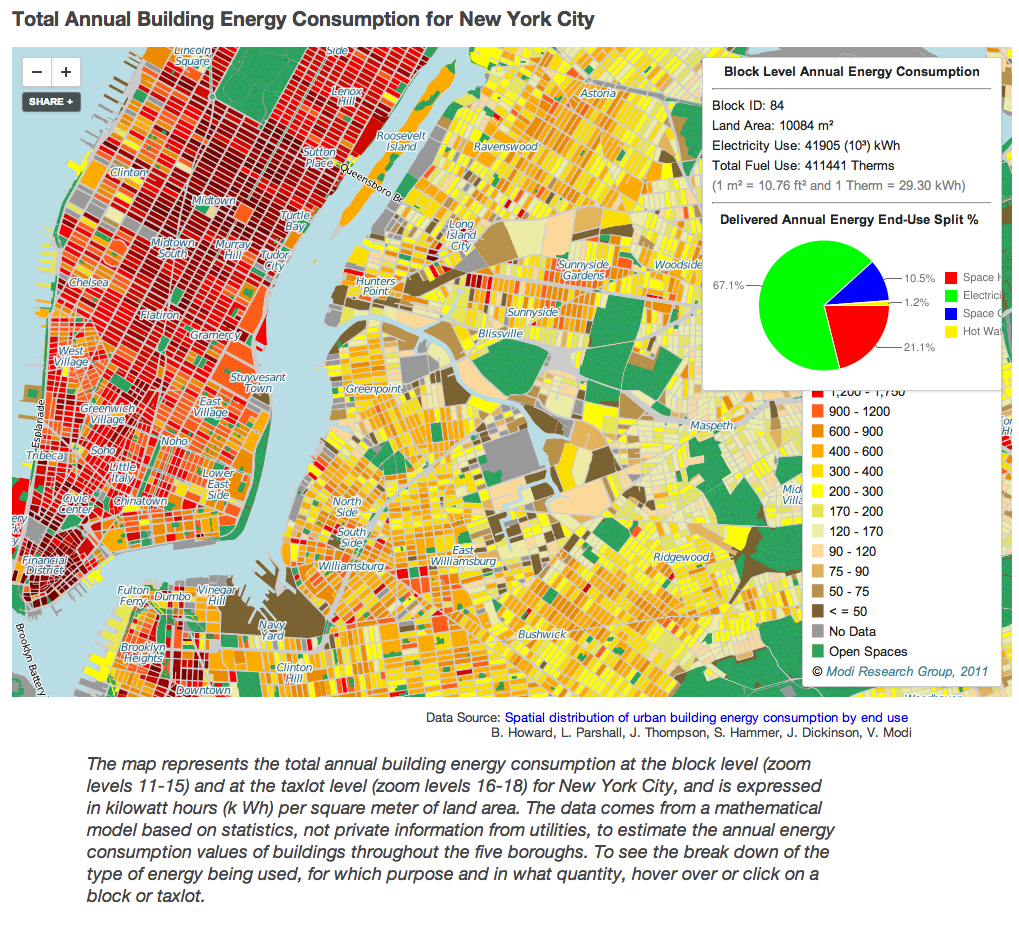 |
| http://engineering.columbia.edu/model-created-map-energy-use-nyc-buildings |
Henry Gifford often points out the we need to measure our energy use if we want to manage it successfully.
January is an excellent month to look over our energy bills for the past year, comparing it with the average use of fellow New Yorkers. We can set goals for the new year and decide on strategies to achieve them.
Here, where many people don't have private cars, our buildings account for two-thirds of the energy used by the city.
Drilling down to the unit level, take a look at the following table. Note these default values represent a very high rate of energy use. Nevertheless our energy cutting needs to start with measurement, so let's fill in our own table of monthly energy use.
Convert therms to kWh by a factor of 29.3
or use the conversion calculator at http://www.unitconversion.org/energy/therms-to-kilowatt-hours-conversion.html.
Convert Btu to kWh by a factor of 0.000293
or use the calculator at http://www.rapidtables.com/convert/energy/BTU_to_kWh.htm.
Default Values for Residential Tenant Space Column 1
|
Column 2
|
Column 3
|
Month
|
Tenant-paid electrical energy use (kWh/unit)
|
Tenant-paid heating energy use (kWh/unit)
|
January
|
420
|
1454
|
February
|
370
|
1238
|
March
|
350
|
1022
|
April
|
340
|
562
|
May
|
360
|
202
|
June
|
430
|
29
|
July
|
530
|
0
|
August
|
570
|
0
|
September
|
440
|
58
|
October
|
360
|
360
|
November
|
350
|
749
|
December
|
380
|
1209
|
Source: Values are based on averaged New York State Energy Research and Development Authority data for multi-family residential buildings in New York City from 2006 – 2009 and correspond to the 25th percentile of building energy performance. http://www.nyc.gov/html/planyc2030/downloads/pdf/040111_final_benchmarking_rule.pdf
Some strategies for reducing home energy use - http://www.motherearthnews.com/renewable-energy/Save-Money-On-Energy.aspx#axzz2MXy3Z1ff
Notice how clever some nonhuman New Yorkers are in energy management:
 |
| NYC pigeons know have to make use of passive solar gain and thermal mass |
 |
| On the other hand, designing a pigeon roost over a pedestrian walkway...well...
Typical Buildings are energy wasters in their construction and operation.
Resilient Buildings are environmentally friendly and energy efficient to the point where they can maintain livable conditions even in the event of extended loss of power or
heating fuel.http://www.resilientdesign.org/resilient-design-strategies/
The Passive House standard for
building heating and cooling is met with only 15 kWh per sq meter per year
(approximately 4750 Btu per sq foot per year or .0475 therms per sq foot
per year). http://www.passivehouse.us/passiveHouse/FAQ.html
Net Zero Buildings have zero net energy consumption and zero net carbon emissions on an annual basis http://en.wikipedia.org/wiki/Zero-energy_building Living Buildings are environmentally sound, generate their own energy, capture and treat all of their water, operate efficiently, and are aesthetically pleasing. http://www.scientificamerican.com/article.cfm?id=earth-talks-living-building Where are we in the spectrum of home energy usage? What can we do to improve?
___________________________________________________________________
Typical Energy Use Resilient Building Passive House Net Zero Living Building |
Subscribe to:
Posts (Atom)